Art / Ecology / Distributed Energy / DIY Research

Biomimetic Solar

An artistic and technological investigation into solar panels made through biomimetic design, organic material experimentation and community-oriented DIY production.

Project Abstract

The project rethinks the solar panel as a functional device, an art object, and a pedagogical tool. Drawing from plant morphology and natural growth processes, it explores how solar technologies can be reimagined through alternative forms of design and production.

By applying electrochemical coatings to diverse surfaces, the work expands from screen-printing techniques to architectural-scale mural interventions. It focuses on reproducible fabrication methods, enabling photovoltaic structures to emerge from accessible, low-cost processes rooted in DIY culture and collective experimentation.

Application diagram
02 / Description

Application

The study of these patterns allows the integration of the notions of temporality and adaptation into the artistic object. In nature, an animal’s skin is not a static surface; the pattern grows and deforms along with the organism. By translating this idea into the screen printing of organic solar cells, it becomes possible to design interfaces that are not perfect grids, but “living” networks that respond to the topography of the support. This approach establishes an experimental methodological framework in which theoretical research on materials and industrial processes becomes a creative process, capable of translating functionality and structure into visual and aesthetic composition, opening new possibilities for innovation in design and artistic research.

Screen printing techniques provide an ideal framework to translate an industrial process of solar panel production into artistic practice. Beyond their historical use in graphic reproduction, serigraphy enables a precise, layer-by-layer deposition of functional materials, closely mirroring the stratified construction of photovoltaic devices.

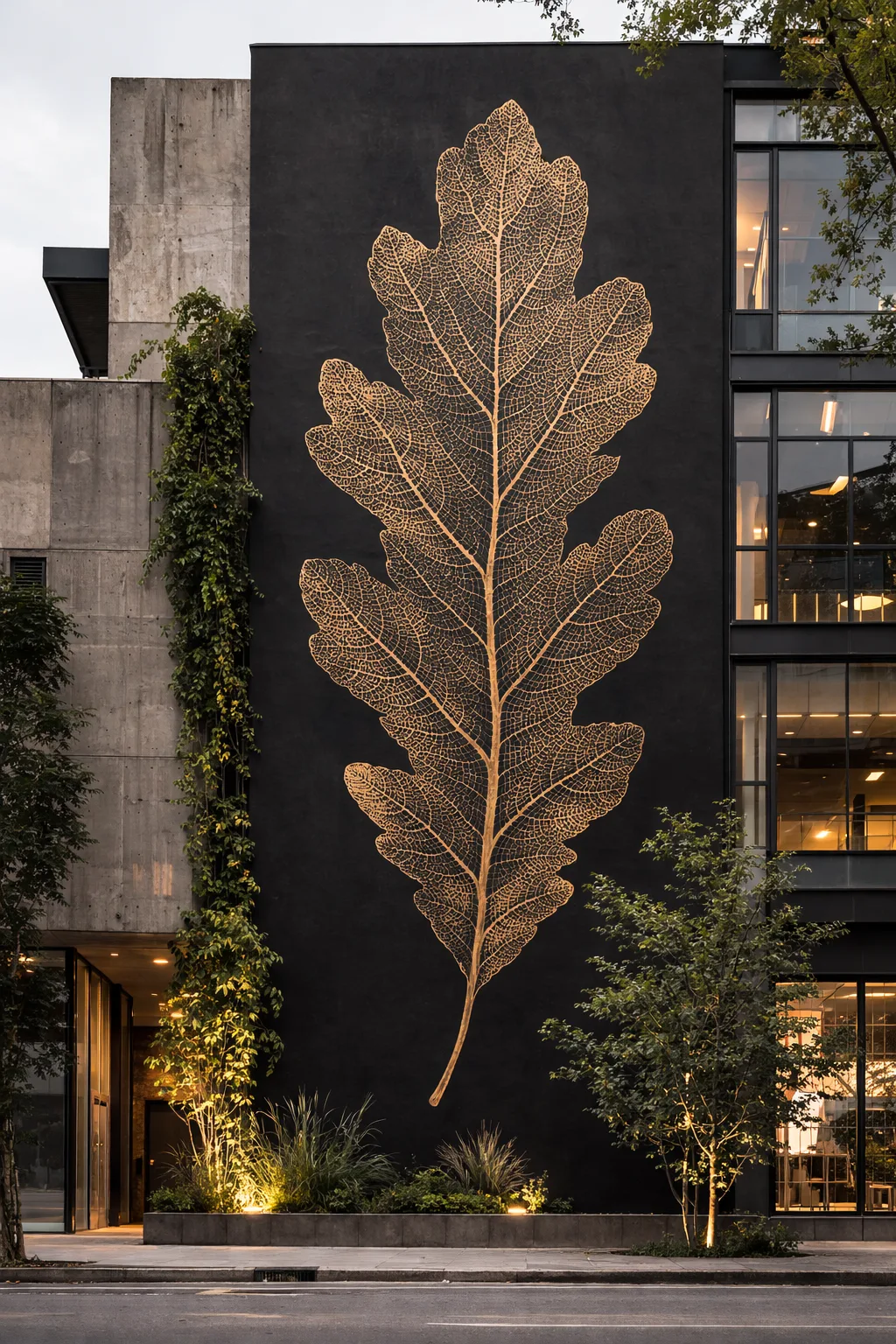
When expanded to the scale of murals, this technique acquires an architectural dimension. The wall becomes not only a support but an active surface, where energy-generating layers can be embedded into the visual structure of the work. The application shifts from manual screen printing toward spray-based deposition systems, while still maintaining the same layered logic. Spraying allows the translation of serigraphic principles into large, continuous surfaces, enabling the coating of entire façades, infrastructures, or irregular constructions with functional materials. Instead of working through discrete frames, the stencil becomes expanded, mobile, or even replaced by masking systems and controlled spray patterns, allowing for greater flexibility and speed across large dimensions.

Biomimetic mural — leaf venation at architectural scale Biomimetic mural alternative view

The mural operates as an integrated system of energy capture, storage, and emission. Sprayed photovoltaic layers collect solar energy during the day and channel it through embedded conductive patterns into a storage system. This stored energy is then used at night to power lighting elements—such as LEDs or electroluminescent layers—allowing the mural to illuminate itself and reveal its internal structure.

In addition, the stored energy can be redirected to external outputs, enabling charging points for mobile devices. Storage itself can also take on a sculptural dimension: battery units can be conceived as artefacts—such as classical vessels—containing organic components that function as large-scale bio-batteries. Furthermore, hybrid devices can be developed in which the vessel integrates both storage and generation, with a solar layer printed directly onto its surface, transforming the object into a self-contained energy unit.

Bio battery vessel Battery section diagram
03 / Process

Fabrication

Central to the fabrication logic is the understanding of each layer's role in energy conversion. The substrate provides structural support; the anode collects positive charges; the hole transport layer (HTL) facilitates charge movement; the active layer absorbs light and separates charges; the electron transport layer (ETL) guides electrons toward the cathode. Each layer is deposited sequentially using screen printing, controlling mesh density, squeegee angle and pressure to ensure uniformity.

Three material models are explored in parallel: a laboratory-grade model based on MIT cellulose solar cell research, a DIY model optimised for serigraphic efficiency using accessible compounds, and an organic/sustainable model using bio-accumulated silica, anthocyanins and lignin extracted from plant matter.

At architectural scale, the system expands into a structure applied directly onto wall surfaces. Silver busbar networks distribute current across large formats. The encapsulation layer — a fluoropolymer (ETFE) varnish — protects organic molecules from UV degradation and atmospheric oxidation. Production cost is estimated at approximately 152 €/m².

The fabrication process also explores organic LED structures as a counterpart: if the cell converts photons into electrons, the OLED performs the inverse, emitting light from stored energy — murals that generate energy during the day and return light at night.

Solar cell layers
ENCAPSULATION
PROTECTIVE VARNISH
CATHODE
TRANSPARENT ELECTRODE
ETL
ELECTRON TRANSPORT
ACTIVE
LIGHT ABSORPTION
HTL
HOLE TRANSPORT
ANODE
CONDUCTIVE BASE
Substrate
R modelTransparent cellulose nanofiber
DIY modelCellulose acetate / bioplastic
Organic modelFlax / hemp cellulose
Anode
R modelITO
DIY modelSilver / copper ink
Organic modelOak charcoal (pyrolysis)
HTL
R modelPEDOT:PSS
DIY modelPEDOT:PSS (solution)
Organic modelPurified lignin
Active
R modelDBP + C60
DIY modelDBP + C60 (solvent)
Organic modelAnthocyanins (blackberry)
ETL
R modelBCP
DIY modelTiO₂
Organic modelEquisetum silica (ash)
Cathode
R modelEvaporated silver
DIY modelSilver mesh
Organic modelGraphite / soot mesh
04 / Participation

Archive

BECOME ACTIVE PART OF THE PROJECT

One of the purposes of this project is to build a participatory archive. People can use the experiments published here and visitors are invited to leave reflections, ideas, more experiments, observations or notes for collaboration and the creation of a network of people and ideas.